لقد تلقينا منتجات جديدة - زوروا كتالوجنا!


Emergency Lighting Lebanon: Exit Signs and Backup Lights for When the Power Cuts

In most countries, emergency lighting is something you think about for a fire drill. In Lebanon, the power cuts every day. Every switch from EDL to the generator, or from the generator to the battery, leaves a few seconds to a few minutes of darkness. In a home that is an inconvenience. In a stairwell, a restaurant kitchen, a shop full of customers or an underground parking, it is when people trip, fall and panic.
Emergency lighting closes that gap. It switches on by itself the moment the power goes, lights the way out, and keeps running on its own battery for hours. Here is how to choose it, where each type fits, and how to keep it working.
What Emergency Lighting Actually Does
Emergency lighting has one job: to let people see well enough to move safely when the normal lighting fails. In practice that means three things.
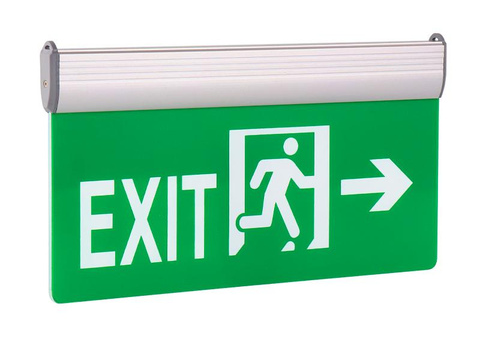
Showing the way out. Exit signs mark the exits and the direction to them, so nobody has to remember the layout of a building in the dark.
Lighting the escape route. Corridors, stairs, landings and exit doors need enough light to walk without tripping, and to see a change in floor level.
Lighting the open areas. Large rooms, shops, restaurants and parking areas need enough light for people to find the route instead of standing still in the dark.
We wrote about why the few seconds before a generator kicks in are so risky in The 30-Second Gap: Preventing Panic When the Generator Switches. This guide is about choosing the right fittings.
Maintained or Non-Maintained: The First Choice
Every emergency light works in one of two modes, and some of ours can do both.
Maintained fittings stay on all the time as normal lights, and carry on from their battery when the power cuts. Exit signs are usually maintained, so the exit is always marked, and maintained lighting suits places that are open to the public.
Non-maintained fittings stay off while the power is on and only switch on when it cuts. They suit back-of-house areas, stairwells and plant rooms where you only need light when the main lighting fails.
Our Emergency Lighting Range
| Product | Best for | Key specs (from the product page) |
|---|---|---|
| LED Emergency Exit Sign, Aluminum and Acrylic | Marking exits and directions | 370 x 180 x 25 mm, 4000K, 180 minutes or more of emergency time, ceiling, wall or hanging mount, single or double face, 3-year warranty |
| 18W LED Emergency Ceiling Light | Corridors, lobbies, rooms | 1100 lm normal, 400 lm in emergency, 180 minutes or more, LiFePO4 battery, IP65, 3000K / 4500K / 6000K |
| 2W Recessed LED Emergency Downlight | Discreet gypsum ceilings | 95 mm diameter, 200 lm at 6000K, 180 minutes, non-maintained |
| 8W LED Emergency Bulkhead Light IP65 | Stairwells, parking, outdoor and humid areas | 700 lm, 180 minutes or more, IP65, maintained or non-maintained, automatic monthly and annual self-test, 3-year warranty |
| Emergency LED Driver Conversion Kit 3-22W | Converting smaller existing fixtures | For 3-22W LED fixtures, 90-120 minutes, transfer in under 0.3 seconds |
| Emergency LED Driver Conversion Kit 15-50W | Converting panels and larger fixtures | For 15-50W LED fixtures, LiFePO4 12.8V 5000mAh, 60-180 minutes, transfer in under 1 second, maintained or non-maintained |
See the full range in our Emergency Lighting category.
Exit Signs: Where They Go
A few simple rules cover most buildings:
- Put a sign above every exit door used for escape, including the final exit to the street.
- Add a sign wherever the route changes direction, so people never reach a corner without knowing which way to turn.
- Make sure a sign is visible from anywhere along the route. In long corridors that can mean more than one.
- Use double-face signs where the route is seen from both sides, such as a sign hung from the ceiling in the middle of a corridor.
Our exit sign can be customized in panel pattern, language and single or double face, so it can match the layout of your building.

Already Have LED Lights? Convert Them Instead of Replacing Them
You do not always need new fittings. An emergency conversion kit adds a battery and an emergency driver to an LED fixture you already own, so the same light keeps working when the power cuts.
Choose the kit by the wattage of the fixture:
- 3-22W kit for downlights, spots and small ceiling lights.
- 15-50W kit for LED panels and larger fixtures. It runs the fixture for 60 to 180 minutes and switches over in under a second.
This is often the neatest option for offices and shops: the ceiling stays exactly as it is, and selected fittings along the escape route become emergency lights. Fitting a kit means wiring it into the fixture, so it should be done by an electrician.
Pick Fittings That Survive Lebanese Conditions
Two things kill emergency lights in Lebanon early: heat and humidity, and the constant cycling between EDL, generator and cut.
Protection rating. For stairwells open to the outside, parking levels, kitchens and coastal buildings, choose IP65 fittings like the bulkhead or the 18W ceiling light. They are sealed against dust and water jets.
Battery. The battery is the part that ages. Our fittings use lithium-based batteries (LiFePO4 or Li-ion, depending on the model) and list their emergency time on the product page. For escape routes, the models rated 180 minutes or more give the most margin.
Voltage swings. Generator switching sends surges through the wiring. Read our guide to 260V generator spikes and your LED fixtures for how to protect the whole installation.
Test It, or It Will Not Work When You Need It
An emergency light that has not been tested is a guess. Two habits fix that:
- Monthly: press the test button on each fitting for a few seconds and check it switches to battery. The indicator on the fitting shows it is charging.
- Watch the duration: if a fitting no longer lasts as long as it should, the battery needs replacing.
The 8W bulkhead takes care of this itself: it runs an automatic 60-minute check every month and a 90-minute check every year, and flashes its indicator so you can see the result.
Rules Depend on Your Building
What a building legally needs depends on its type, size and use, and on what the authorities require for your project. Your engineer or safety consultant should confirm the requirements. Our part is supplying the right fittings, helping you choose where they go, and making sure they suit the conditions they will work in.
Plan It in Four Steps
- Walk the escape routes from every room to the street and mark every exit and change of direction.
- Mark where people could trip or get stuck in the dark: stairs, ramps, kitchens, parking ramps.
- List the LED fixtures already there that could be converted with a kit.
- Choose IP65 fittings for anything outdoors, damp or dusty.
Send us your floor plan or a few photos of the building, or visit our showroom in Mtaileb to see the exit signs and emergency lights working. We will suggest what goes where. Contact us here.