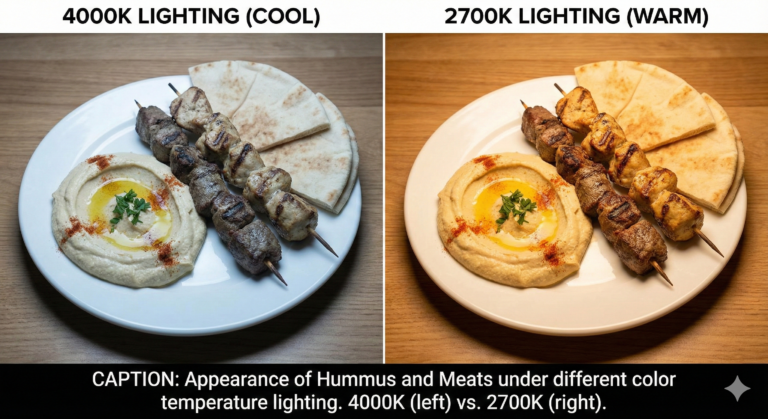
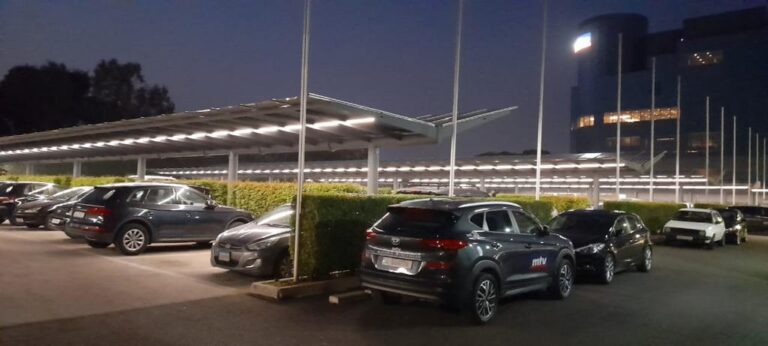
We received new products - Visit our catalog!
How to Light Your Whole House on 1 Amp: The Solar Survival Guide

By Anthony Gemayel, Electrical Engineer Estimated Reading Time: 6 Minutes
It is 8:00 PM in Lebanon. The state electricity is off. The generator is off. You are running on your Solar Batteries.
You are standing in front of your Inverter screen, watching the battery percentage drop. 85%… 84%… You yell at the kids: “Turn off the lights in the hallway! Use one light in the kitchen!”
You are living in the dark to save power. But here is the secret that most solar installers didn’t tell you: The problem isn’t the number of lights you have on. It’s the kind of lights you have on.
At EMC Superled, we believe you shouldn’t have to choose between having light and having battery life. Here is how to light your entire apartment using just 1 Amp.
The Definition: Luminous Efficacy
Luminous Efficacy is the “Miles Per Gallon” of lighting. It measures how much light you get for every Watt of electricity.
- Standard Market LED: 80 Lumens per Watt. (Inefficient engine).
- EMC High-Efficiency LED: 140 Lumens per Watt. (Hybrid engine).
The Math: To get 1000 Lumens (standard room brightness), a cheap bulb burns 12.5 Watts. An EMC bulb burns just 7 Watts. That is a 44% energy saving instantly.
1. The “Power Factor” Secret (Why Your Inverter Hates Cheap Bulbs)
This is a bit technical, but if you own a solar system, you need to know it. There are two ways to measure power:
- Real Power (Watts): What the bulb actually uses.
- Apparent Power (VA): What the inverter thinks it is supplying.
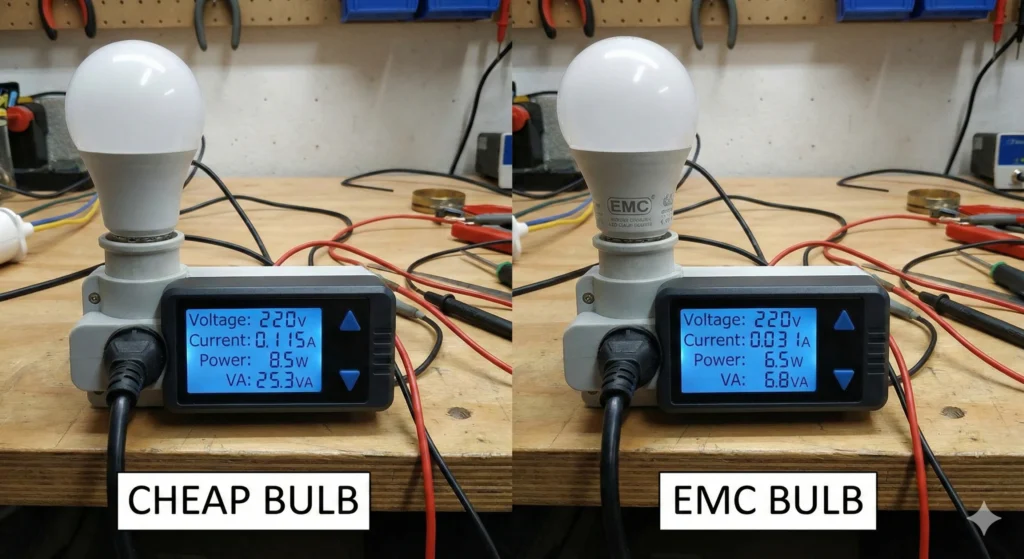
If a bulb has a low Power Factor (PF 0.5) which is common for cheap imports it is “dirty.” It asks the inverter for double the power it actually needs.
- Cheap Bulb: Uses 10 Watts, but demands 20 VA from the inverter.
- EMC Bulb: Uses 10 Watts, and demands 11 VA (PF > 0.9).
The Result: If you use low-PF bulbs, your expensive 5kW inverter heats up and wastes battery energy just trying to keep the “dirty” bulbs running.
2. The “1 Amp” Challenge
Let’s take a typical Lebanese apartment with 20 lights turned on (Salon, Kitchen, Bedrooms, Corridors).
Scenario A: The “Market” Setup
- 20 bulbs x 12 Watts (Low efficiency) = 240 Watts.
- Inverter Load (Apparent Power): 480 VA.
- Current Draw: ~2.2 Amps.
Scenario B: The EMC “Solar Friendly” Setup
- 20 bulbs x 7 Watts (High efficiency) = 140 Watts.
- Inverter Load (Apparent Power): 155 VA.
- Current Draw: ~0.7 Amps.
The Difference: By switching to EMC, you dropped your load from 2.2 Amps to under 1 Amp. That extra 1.5 Amps you saved? That’s enough to run your TV, your Fridge, and your WiFi router for free.
3. Heat = Waste
Go touch one of the bulbs currently running in your house (be careful). Is it too hot to touch? If it is burning hot, that is wasted battery power.
An LED chip is supposed to turn electricity into light. If it turns electricity into heat, it is failing. Cheap bulbs get hot because they use inefficient chips and poor heat sinks. Every degree of heat is a minute of battery life lost.
The EMC Test: Touch our High-Efficiency bulb after 1 hour. It will be warm, but safe to touch. We focus on photons, not heat.
Conclusion: Stop Wasting Your Investment
You spent thousands of dollars on Solar Panels and Lithium Batteries. Why would you ruin that investment by plugging in a $1.00 inefficient light bulb?
Lighting is the “base load” of your house. If you optimize it, everything else runs better.
The “Solar Audit”: Bring your electricity bill or a photo of your inverter screen to the EMC Showroom. We will calculate exactly how many Amps you can save by upgrading your lighting.
Contact EMC SUPERLED, LED Lighting Experts in Mtaileb Lebanon