We received new products - Visit our catalog!

How to Choose the Right LED Lights for Your Home in Lebanon (2025 Guide)

By Anthony Gemayel, Electrical Engineer Estimated Reading Time: 8 Minutes
Walking into an electrical shop in Lebanon can be overwhelming. You are surrounded by boxes labeled with confusing numbers: Watts, Lumens, Kelvin, Ra, PF.
Usually, you just ask the shopkeeper: “A3tineh lamba mniha” (Give me a good bulb). He hands you a box, you pay, and you go home.
Two months later, the light is flickering, or your living room looks like a hospital operating theater because the color is wrong.
At EMC Superled, we believe you shouldn’t need an engineering degree to buy a light bulb—but you do need to know the basics to avoid getting scammed. Here is the ultimate guide to buying LED lights in Lebanon for 2025.
The Cheat Sheet (For the Busy Reader)
Don’t have time to read? Here is the summary:
- Brightness: Look for Lumens, not Watts. (10W LED ≈ 800 Lumens).
- Color:
- 3000K (Warm): Salon, Bedroom.
- 4000K (Natural): Kitchen, Bathroom.
- 6500K (Cool): Balcony, Garage ONLY.
- Voltage: Must be 85V-265V (Wide Range) to survive the generator switch.
- Quality: If it feels light like a feather, it’s junk. Heavy = Good Heat Sink.
1. The “Watts” Trap: Stop Buying by Wattage!
For 50 years, we bought light bulbs based on Watts. “Give me a 100-Watt bulb.” In the LED era, Watts measure energy consumption, not brightness.
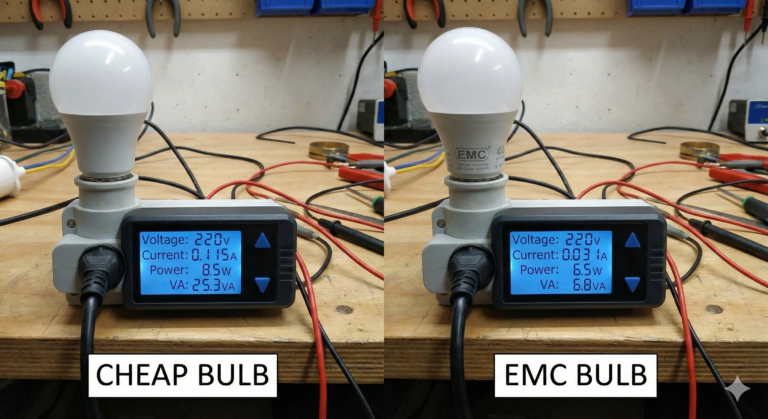
A cheap LED might use 10 Watts to give you 600 Lumens (inefficient). A high-quality EMC LED uses 10 Watts to give you 1000 Lumens (efficient).
The Golden Rule: Look for the Lumens number on the box.
- 400 – 500 Lumens: Desk lamp / Bedside table.
- 800 – 1000 Lumens: Standard room light (replaces old 60W bulb).
- 1500+ Lumens: Large salon or kitchen.
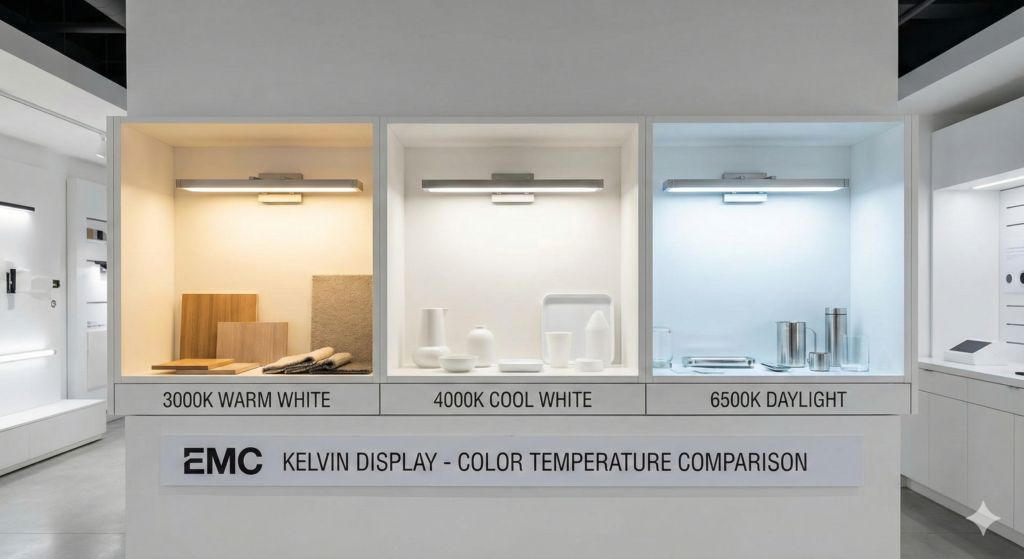
2. Color Temperature: Why Your Salon Looks Like a Hospital
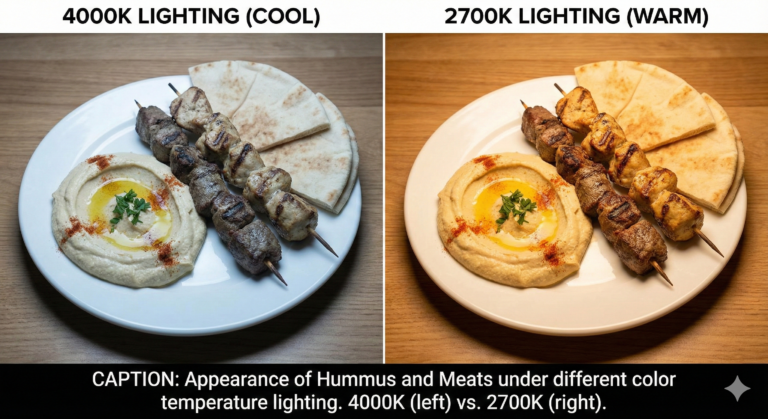
Have you ever installed a new light and felt like you were in a dentist’s office? That’s because you bought 6500K (Cool White).
In Lebanon, there is a bad habit of installing Cool White everywhere because people think it’s “brighter.” It’s not brighter; it’s just bluer.
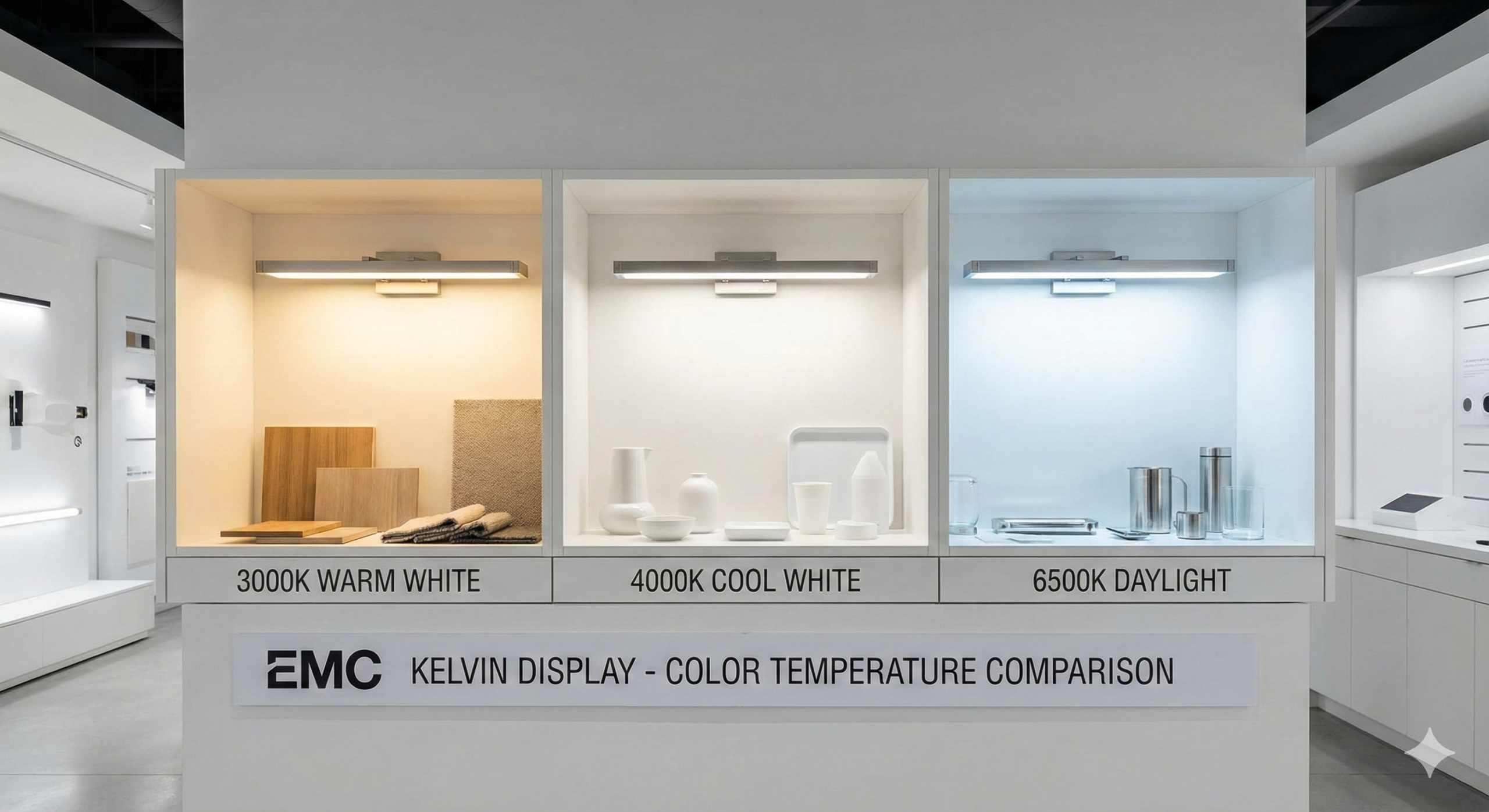
The Kelvin Scale (K)
- 3000K (Warm White): Yellow/Gold tone.
- Where to use: Salons, Bedrooms, Dining Rooms. It makes the house feel cozy and expensive.
- 4000K (Natural White): Neutral/Crisp tone.
- Where to use: Kitchens (to see food color), Bathrooms (for makeup), Offices.
- 6500K (Cool White): Blue/Ice tone.
- Where to use: Garages, Balconies, Storage Rooms. Never in the salon.
3. The “Lebanon Factor”: Voltage Protection
This is the most critical section for anyone living in Lebanon.
Our grid is unstable. We switch between EDL (State Electricity) and Generators multiple times a day.
- The Spike: When the generator kicks in, voltage can spike up to 260V.
- The Drop: When the load is high, voltage can drop to 180V.
Most cheap imported LEDs are rated for 220V-240V (European Standard). When the voltage hits 190V, they flicker. When it hits 250V, the capacitor blows up.
The EMC Solution: We design our Isolated Drivers specifically for the Lebanese grid. They are rated for 85V – 265V. This means your voltage can drop to 100V, and our light will stay on at full brightness without flickering. It can spike to 260V, and it won’t burn out.
![INSERT IMAGE: Close up of an EMC Driver Label showing “Input: AC 85-265V” vs a competitor label showing “220V Only”.]
4. Know Your Base (The Socket Types)
Before you come to the shop, take a picture of your old bulb. Here are the most common types in Lebanon:
- E27 (The Big Screw): The standard bulb for chandeliers and lamps.
- E14 (The Small Screw): Usually for smaller chandeliers (candle shape).
- GU10 (The Spot): The twist-and-lock bulb found in false ceilings.
- MR16 (The 12V Spot): Requires a transformer. (We recommend switching to GU10 220V to remove the transformer failure point).
5. How to Spot a “Fake” LED
Lebanon is flooded with “Commercial Grade” LEDs. Here is a quick 3-second test to see if a bulb is quality:
- Weigh It: A good LED has an aluminum heat sink. It should feel heavy. If it feels like an empty plastic ball, put it back.
- Shake It: If you hear rattling, the soldering is bad.
- Check the Warranty: Does the box have a local phone number? Or just a “CE” mark (which usually stands for ‘China Export’ in this case)? At EMC, our warranty is printed on the box with our factory address in Lebanon.
Conclusion: Buy Nice or Buy Twice
You can buy a generic bulb for $1.00. It will last 3 months, flicker when the generator starts, and turn your salon blue. Or you can buy an Engineered EMC Bulb for a little more. It will last 5 years, handle the voltage drops, and make your home look beautiful.
Don’t know what you need? Take a photo of your room and bring it to our showroom. Our engineers will tell you exactly how many Lumens and what Color Temperature you need.