لقد تلقينا منتجات جديدة - زوروا كتالوجنا!
Why Street Lights Turn Purple: The Municipality’s Guide to LED Roadway Lighting

By Anthony Gemayel, Electrical Engineer Estimated Reading Time: 6 Minutes
Drive through any village in Lebanon at night, and you will see a strange phenomenon. Some street lights are dead. Some are flickering. And many of them are glowing a weird, dim shade of Purple or Blue.
For a Municipality (Baladiye), this is a nightmare. You spent public money to upgrade to LED to “save energy,” but two years later, the road is dark, and the citizens are complaining.
Why does this happen? And why do some LED street lights last 10 years while others fail in 10 months?
It’s not bad luck. It’s bad engineering. Here is what every Mayor and Municipal Engineer needs to know before signing the next lighting contract.
1. The “Purple” Plague (Phosphor Delamination)
That purple color you see isn’t a special effect. It’s a sign of a dying LED.
White LEDs are actually Blue chips covered in a Yellow Phosphor coating.
- Cheap LEDs: Use low-quality glue to attach the phosphor.
- The Heat Factor: When the street light gets hot (and cheap fixtures get very hot), the phosphor cracks and peels off.
- The Result: The yellow is gone, and you are left seeing the raw Blue/Purple chip underneath. The light output drops by 50%, and the road becomes dangerous.
The EMC Standard: We use Tier-1 chips (like Cree or Lumileds) with ceramic substrates that bond the phosphor at a molecular level. Our lights stay white for 50,000 hours.
![INSERT IMAGE: A photo of a road lit by failing “Purple” street lights vs. a road lit by bright white EMC lights.]
2. The https://www.google.com/search?q=%231 Killer: Lightning and Surges
Outdoor lights are sitting ducks. They are mounted 8 meters high on metal poles, fully exposed to:
- Lightning Strikes: Even a strike 1km away sends a shockwave through the ground wire.
- Grid Spikes: When the village generator switches over, massive voltage spikes travel down the street line.
If you buy a standard “Indoor Grade” floodlight and put it on a pole, it will blow up during the first winter storm.
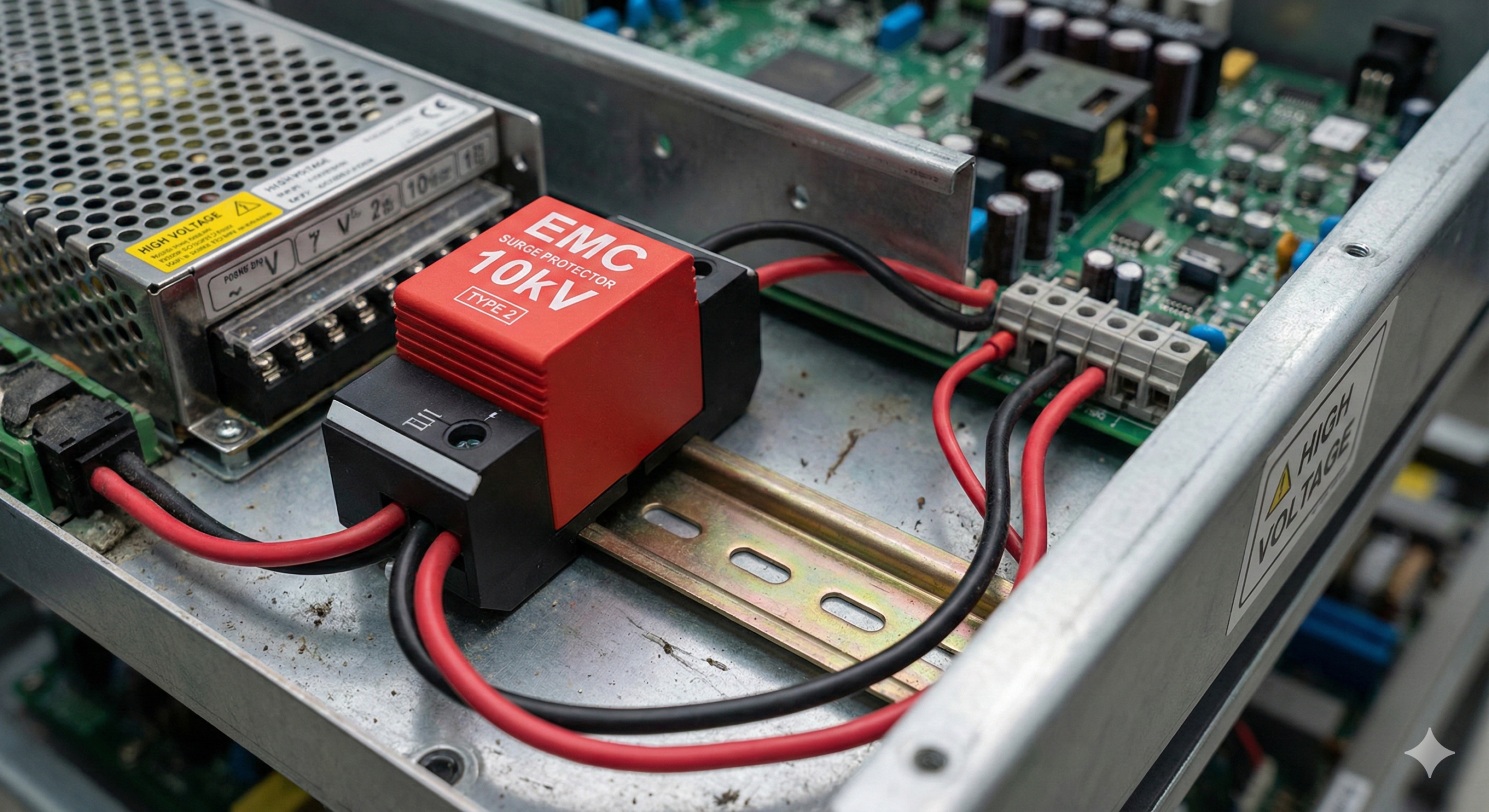
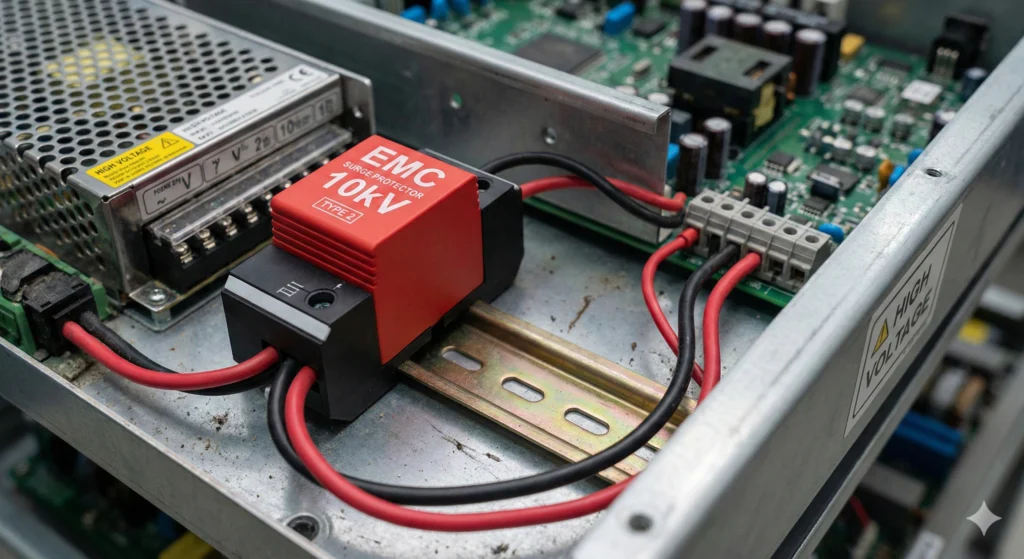
The Fix: 10kV Surge Protection (SPD) Every EMC Street Light comes with a dedicated 10kV SPD (Surge Protection Device). Think of it as an airbag for the light. If a 5,000-volt spike comes down the line, the SPD absorbs it and sacrifices itself to save the expensive driver and LED chips.
- Without SPD: You lose the whole fixture ($$$).
- With SPD: You might (rarely) lose the $5 SPD unit, which takes 5 minutes to replace.
3. Light the Road, Not the Sky (Optics Matter)
A common mistake is buying a generic “Flood Light” and pointing it at the road.
- The Problem: A flood light sprays light in a 120-degree circle. Half the light goes into the sky (waste), and half goes into the neighbor’s bedroom window (complaints). The road remains dark spots between poles.
The Solution: Asymmetric Lenses (Type II / Type III) We don’t use glass covers; we use engineered Optical Lenses. These lenses bend the light beam into a rectangular shape specifically designed to stretch down the road.
- Uniformity: No “Zebra Effect” (Dark-Bright-Dark). The road is evenly lit from pole to pole.
- Efficiency: You get more lux on the asphalt using less wattage because you aren’t lighting the fields behind the pole.
4. The Fuel Bill: High Efficiency = Lower Amps
Most Municipalities run their street lights on the village generator. Fuel is expensive. Amps are precious.
- Cheap Light: 100 Watts = 8,000 Lumens (80 lm/W).
- EMC Light: 100 Watts = 14,000 Lumens (140 lm/W).
This means you can use a 60W EMC light to do the same job as a 100W cheap light. Multiply that by 500 poles in a village. That is a massive reduction in the load on your generator, saving thousands of dollars in diesel every year.
Conclusion: Respect the Public Budget
Cheap street lights are expensive. They turn purple, they annoy residents with glare, and they blow up in winter.
Free Road Study: Don’t guess the wattage. Send us your street map (pole distance and height). We will run a Dialux Simulation to tell you exactly:
- Which lens Type to use.
- The exact wattage needed to meet international safety standards.
- How much diesel you will save compared to your old lights.