لقد تلقينا منتجات جديدة - زوروا كتالوجنا!

LED Strips 101: How to Get a “Dotless” Look for Your Ceiling

By Anthony Gemayel, Electrical Engineer Estimated Reading Time: 6 Minutes
If you scroll through Instagram or Pinterest for “Modern Lebanese Home Design,” you will see one thing everywhere: Hidden Lighting.
Lines of light under kitchen cabinets. Soft glows inside drop ceilings (faux plafond). Backlit mirrors.
It looks amazing in the photos. But when you try to do it yourself (or hire a cheap contractor), it often looks terrible. You see ugly “dots” reflected on your shiny floor. The tape peels off the wood after one summer. The transformer starts buzzing.
At EMC Superled, we sell kilometers of LED strip every month. We know exactly why these installations fail. Here is your guide to getting that smooth, “laser beam” look without the headaches.
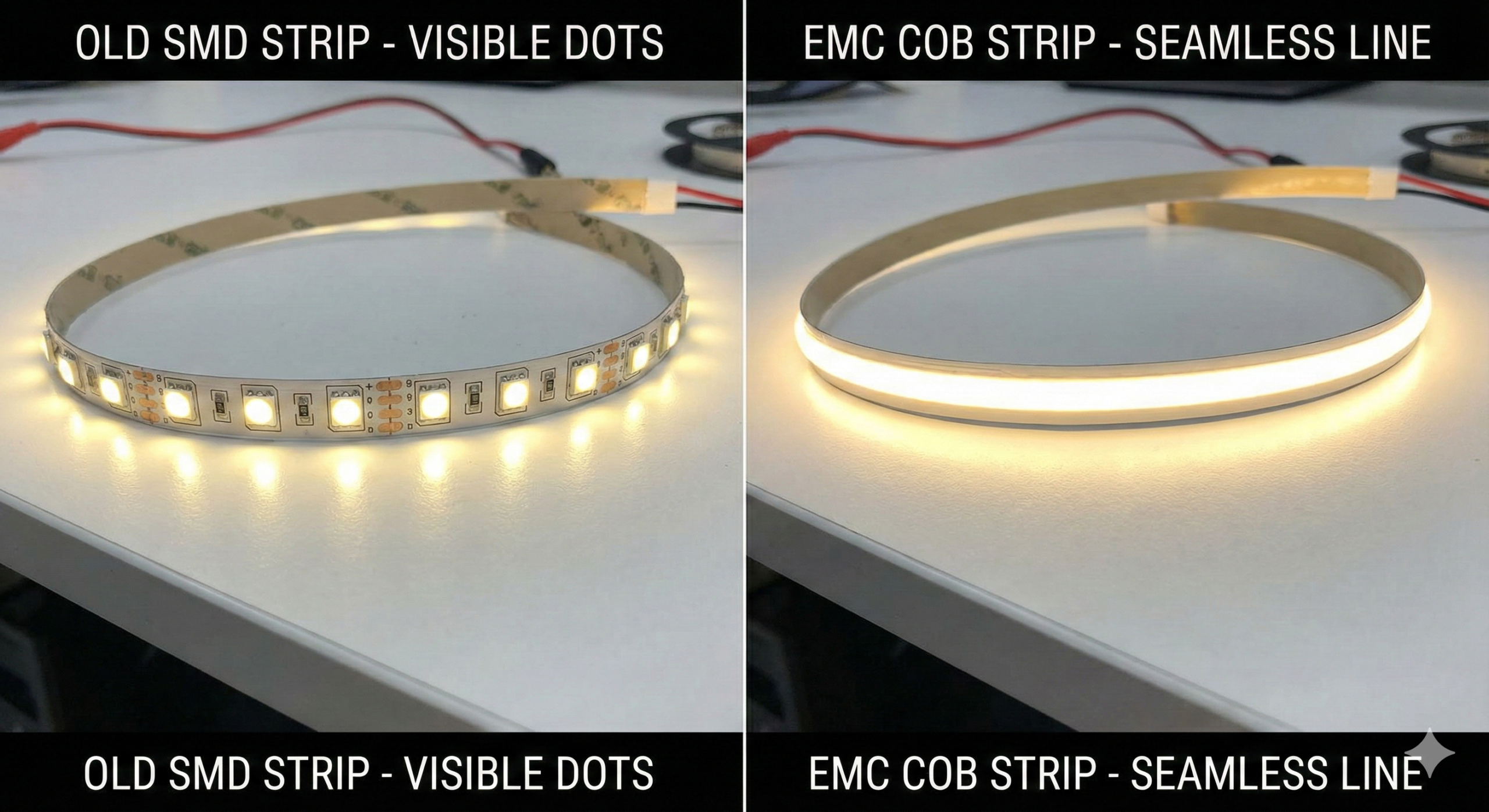
The Evolution: Say Goodbye to “Dots” (SMD vs. COB)
For years, we used SMD Strips (Surface Mounted Device). These had individual LED chips spaced apart.
- The Problem: If you looked at the reflection on a marble floor, you saw “dot… dot… dot.” It looked cheap.
The Solution: COB (Chip on Board) In 2025, if you are installing hidden lighting, you must use COB Strips. COB technology packs hundreds of tiny chips so close together (often 480 chips per meter) covered by a continuous layer of yellow phosphor.
- The Result: A solid, continuous line of light. No dots. Just a pure, smooth glow.
1. Why You Need Aluminum Profiles (Don’t Stick It on Gypsum!)
I see this mistake every day. A painter finishes the gypsum ceiling. The electrician comes and sticks the LED tape directly onto the paper/paint.
Three months later, two things happen:
- The Peel: The heat from the LED softens the glue. The strip falls off and hangs down like a sad snake.
- The Burn: LED chips generate heat. Gypsum is an insulator (it traps heat). The LED overheats and burns out.
The Fix: You must use an Aluminum Profile. The profile acts as a Heat Sink, pulling the heat away from the strip and extending its life by years. It also provides a clean, flat surface for the 3M adhesive to stick to permanently.
2. The Voltage Debate: 12V vs. 24V
Most cheap strips in the market are 12V. Professional strips (like EMC’s Architectural Series) are usually 24V.
Why does it matter? Voltage Drop.
- 12V: If you run a strip longer than 5 meters, the end of the strip will look dimmer than the start. The current gets “tired.”
- 24V: The higher pressure allows the current to travel further. You can run up to 10 meters continuously with perfect, uniform brightness from start to finish.
Pro Tip: If you are lighting a large salon cove, always ask for 24V COB Strips.
3. Power Supply Math: Don’t Kill Your Transformer
The transformer (or driver) is the engine of your lighting. If you buy one that is too small, it will overheat and fail.
How to Calculate the Right Size:
- Check Watts per Meter: Example, your COB strip is 10W/meter.
- Measure Length: You are installing 5 meters.
- Calculate Load: 10W x 5m = 50 Watts.
- Add the Safety Buffer: Never run a driver at 100%. Add 20%.
- 50W + 20% = 60 Watts.
Result: You need a 60W Driver (or larger). If you buy a 50W driver, it will run hot and die in 6 months.
4. Color Consistency (Binning)
Have you ever seen a cove light where the first 5 meters are “Warm White” and the next 5 meters look slightly pink or green? That’s because the supplier bought cheap strips from different “Bins” (batches).
At EMC, we use MacAdam Step 3 Binning. This is a fancy engineering way of saying that every single roll of LED strip in our warehouse is color-matched. If you buy 100 meters today and 50 meters next year, they will be the exact same shade of white.
Conclusion: It’s All in the Details
Hidden lighting is supposed to be minimal, but installing it is technical. Don’t let a contractor ruin your expensive ceiling with dotty, peeling tape.
Planning a renovation? Bring your ceiling plan (AutoCAD or PDF) to the EMC Showroom. We will calculate the exact length of COB strip, the number of profiles, and the size of the drivers you need. We cut everything to measure so your electrician just has to plug it in.