لقد تلقينا منتجات جديدة - زوروا كتالوجنا!

Why Your Expensive Marble Looks Cheap: The Architect’s Guide to CRI and “The R9 Value”

By Anthony Gemayel, Electrical Engineer Estimated Reading Time: 5 Minutes
Imagine this: You have just spent months designing a luxury apartment in Achrafieh. You specified Italian Carrara marble, rich walnut cabinetry, and velvet upholstery. The material board was perfect.
Then, the contractor hands over the keys. You walk in, flip the switch, and your heart sinks.
The marble looks grey and flat. The walnut looks like laminate. The client looks pale, like they have the flu.
What happened? The contractor didn’t change the paint. They didn’t change the wood. They changed the lights.
To save $20 per meter, they swapped your specified LED strip for a generic “3000K Warm White” from the market. They told you, “It’s the same color temperature, boss.”
They lied. Well, mostly. It is the same color temperature, but it is missing the most important ingredient for luxury design: Red.
The Hidden Metric: It’s Not About “Warm White”
Most architects know about Kelvin (2700K vs 3000K). But in 2025, if you aren’t specifying CRI and R9, you are gambling with your design.
The Technical Definition: CRI (Color Rendering Index) measures how accurately a light source reveals colors compared to the sun. R9 (The Red Value) measures how accurately it reveals saturated red.
Here is the catch: The standard CRI score (Ra) is an average of 8 pastel colors. It ignores red. A cheap LED can score an “80” on CRI while having a negative R9 score. This is why standard LEDs make homes feel like hospitals.
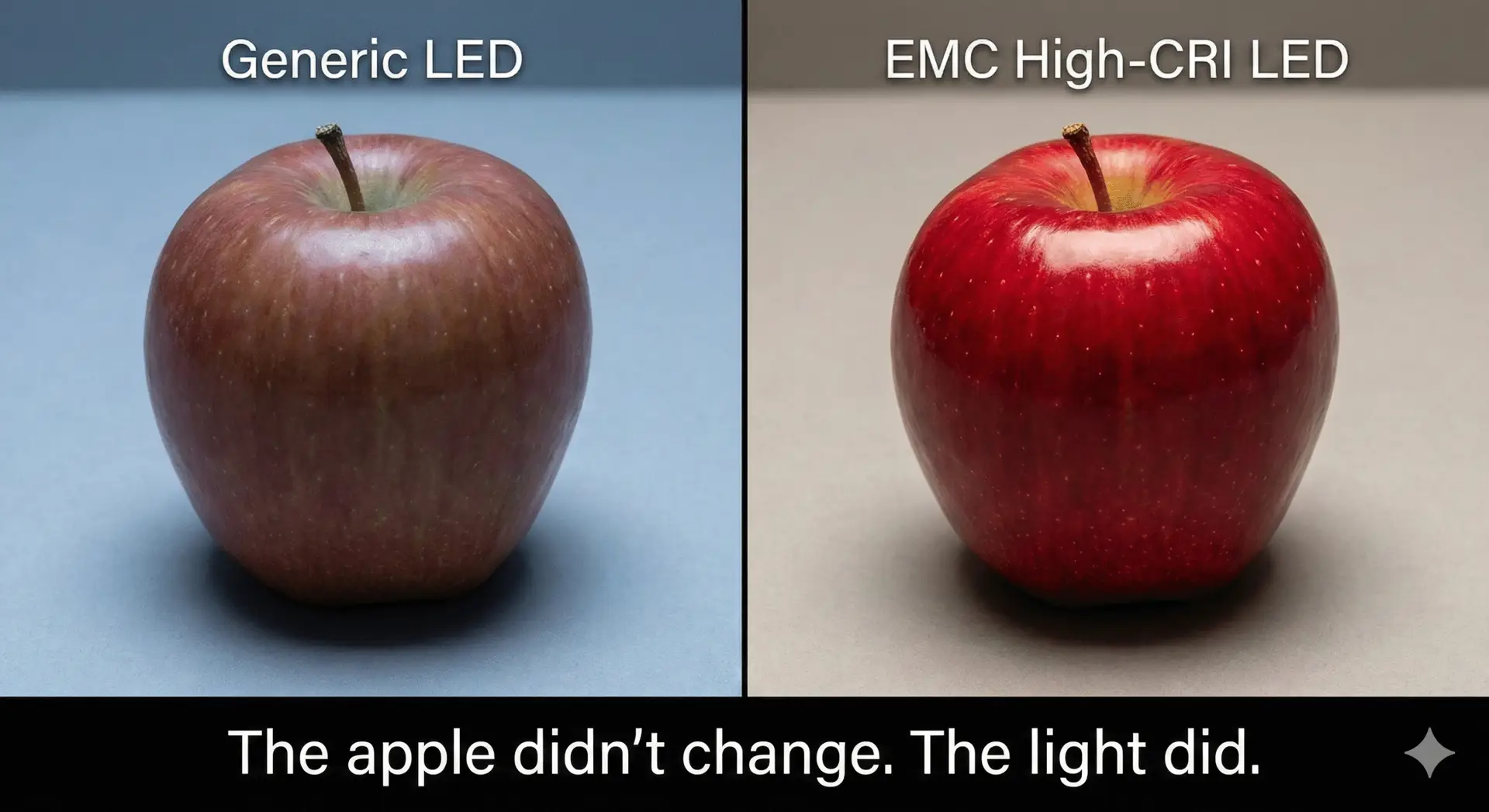
1. The “Red Apple” Test
You don’t need a spectrometer to see the difference. You just need an apple.
Standard LEDs are essentially blue chips coated in yellow phosphor. They are physically incapable of producing deep, rich reds unless they are engineered specifically for it.
When you put a red apple (or your client’s skin, or that expensive mahogany wood) under a standard LED, the light source cannot reflect the red back to your eye because there is no red in the light beam. The object looks muddy and dull.
At EMC Superled, we customize our phosphor mix. We don’t just aim for “brightness”; we aim for “spectrum saturation.”

2. Why “CRI 80” is the Enemy of Luxury
For a warehouse or a parking garage, CRI 70 or 80 is fine. You just need to see where you are driving.
But for a residential salon, a jewelry store, or a hotel lobby, CRI 80 is catastrophic.
- Wood Grain: Losing the red tones makes wood look green or grey.
- Stone Veins: Marble loses its depth and contrast.
- Skin Tones: This is the big one. Low R9 values make skin look grey/green (the “zombie effect”). If your client looks sick in their own bathroom mirror, they aren’t going to love the apartment.
The EMC Standard: For all our architectural lines, we push for CRI > 90 and R9 > 50. This is “Gallery Grade” lighting, usually reserved for museums, now available for your residential projects.
3. The Contractor vs. The Designer: Protect Your Spec
We see it on every site in Lebanon. The Architect writes “LED Strip 3000K” in the Bill of Quantities (BOQ). The Contractor buys the cheapest reel he can find in the market.
How to stop this? You need to weaponize your datasheet. Don’t just specify the temperature. Specify the quality.
Copy-Paste this into your next BOQ:
“LED Linear Strip, 3000K, 1200lm/m, CRI > 90, R9 > 50. Contractor must submit photometric test report confirming R9 value prior to installation.”
When the contractor complains that they “can’t find this,” call us. We manufacture it right here. We print the R9 value on the box because we have nothing to hide.
Conclusion: Don’t Let a $10 Light Ruin a $10,000 Wall
You spend thousands of dollars selecting the perfect beige, the perfect greige, and the perfect taupe. Don’t let a cheap light bulb turn them all into the same muddy grey.
Lighting is the medium through which your work is seen. If the light is cheap, the architecture looks cheap.
Want to see the difference yourself? Bring a sample of your wood or fabric to the EMC Showroom. We’ll put it under a “Market LED” and an “EMC High-CRI LED.” You won’t believe it’s the same piece of wood.
Contact EMC SUPERLED, LED Lighting Experts in Mtaileb Lebanon