We received new products - Visit our catalog!
Optimizing LED Driver Efficiency for Lebanon’s Volatile Power Grid

The Unbearable Flicker: When Your "Industrial Grade" LED Driver Meets Lebanon’s Grid
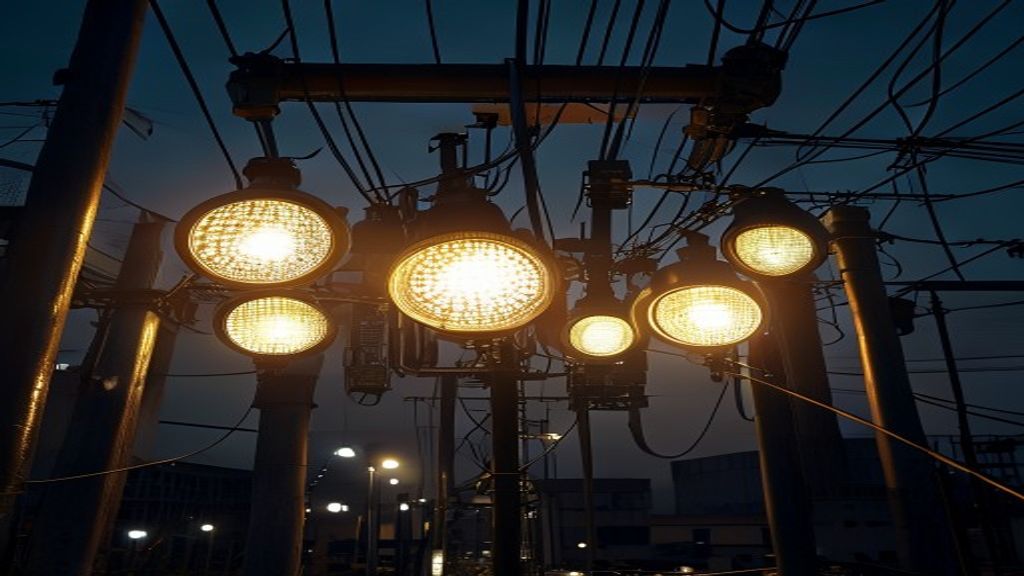
Let’s be brutally honest. You’ve just finished a meticulous lighting design, calculated lumen output to the decimal, specified top-tier luminaires, and then… the generator kicks in, surges to 260V, drops to 190V when a dozen AC units start, and by next month, you’re looking at a cascade of flickering lights or, worse, completely dead fixtures. The promise of 50,000 hours? A cruel joke when your driver can’t even handle a single day on Lebanon’s rollercoaster grid. This isn’t just an inconvenience; it’s a reputation killer, a budget drain, and frankly, an insult to sound engineering.
What’s Killing Your Drivers? Understanding the Enemy
What’s truly killing those supposed ‘industrial-grade’ drivers? It’s not just the voltage amplitude, but the quality of that voltage.
Total Harmonic Distortion (THD): A measurement of the harmonic content present in an AC waveform compared to the fundamental frequency. In LED drivers, high THD indicates a non-linear load injecting significant harmonic currents back into the grid, leading to inefficiencies, increased losses in transformers, and potential overheating of neutral conductors. For optimal grid compatibility, a driver’s current THD should ideally be below 10-15%.
The Engineering Reality: Why "Standard" Drivers Crumble Here
Most off-the-shelf drivers, even those with impressive datasheets boasting PF > 0.98 and efficiency over 90%, are designed for stable, predictable grids. They’re built for Europe or North America, not for Beirut’s unique blend of inconsistent utility power and roaring, unregulated generators. When a driver engineered for a +/-10% voltage tolerance suddenly faces swings of +/-20-30%, its critical components are stressed to their breaking point.
- Capacitors: The bane of every cheap driver. Undersized or low-grade electrolytic capacitors are the first to fail under sustained high ripple currents and thermal stress from inadequate cooling. Their Equivalent Series Resistance (ESR) skyrockets, efficiency plummets, and boom – dead driver. We’re talking about components rated for 85°C in an ambient 40°C+ environment, operating way beyond their limits.
- MOV (Metal Oxide Varistor): Often underspecced or completely omitted in cost-cutting designs, leaving the driver utterly vulnerable to the transient overvoltages that are a daily reality here. A proper MOV, rated for our specific surge profiles (e.g., 4kV common mode, 2kV differential mode), is non-negotiable.
- Thermal Management: A driver operating inefficiently generates more heat. Coupled with poor heat sinking, compact enclosures, and high ambient temperatures, the internal junction temperatures quickly exceed design limits, accelerating component degradation. You might get a 140lm/W fixture efficiency, but if the driver can’t sustain it, the real Lumen Maintenance (Lxx) is a fraction of the advertised 50,000 hours.
These ‘European’ drivers, often sourced from online marketplaces, invariably cut corners on essential protective circuitry and robust component selection. Their ‘specs’ are theoretical, validated in labs with pristine power, not battle-tested against a true Lebanese power profile.
The EMC Superled Advantage: Engineered for Resilience, Made in Lebanon
This is where local engineering isn’t just a marketing slogan; it’s a necessity. At EMC Superled, our drivers aren’t simply assembled; they’re designed, tested, and fine-tuned right here in our factory in Lebanon. We understand the specific waveform distortions, the brutal voltage fluctuations, and yes, even the occasional phase loss that these generic imports simply can’t handle.
Our local production means:
- Robust Design: We select components (capacitors rated for 105°C, oversized MOVs, industrial-grade ICs with wider input voltage ranges) specifically to withstand our grid’s abuse. Our designs explicitly account for high ambient temperatures and erratic power delivery.
- Rapid Prototyping & Testing: We don’t rely on theoretical datasheets from a factory thousands of miles away. We push our drivers to their limits in our lab, simulating our real-world conditions – from sustained high voltage to rapid fluctuations – ensuring genuine longevity.
- Unmatched Local Support: When a problem arises, you’re not waiting 3 months for a container from China to clear customs, hoping it contains the right replacement. Our warranty is real, our spare parts are in stock, and our engineers are on the ground, ready to diagnose and rectify issues, ensuring minimal downtime for your critical projects.
We’re building drivers for resilience, for longevity, for Lebanon.
Elevate Your Projects: A Consultative Approach to Reliability
Don’t just take our word for it. If you’re wrestling with premature driver failures, inconsistent lighting, or simply want to ensure your next project stands the test of Lebanon’s grid, bring your burnt-out drivers to our lab. Let our engineers conduct a forensic analysis. We’ll show you precisely why they failed and how a purpose-built, locally optimized solution can save your project, your reputation, and your bottom line. Alternatively, book a session with us to discuss tailored solutions for your next demanding project; we offer detailed technical consultations, Dialux simulations, and real-world performance data, not just glossy brochures.